
Edition 000005Issue date September 23, 2026Publication date September 23, 2026Constitution 1.0
← Edition 000005ER-A00026Article Version 2

The Frontier

NIST Says Z.ai’s GLM-5.3 Leads Its Open-Weight Cyber Comparison

The assessment reported a substantial gap with U.S. frontier models, while independent analysis cautioned that the tests do not establish real-world operational capability.

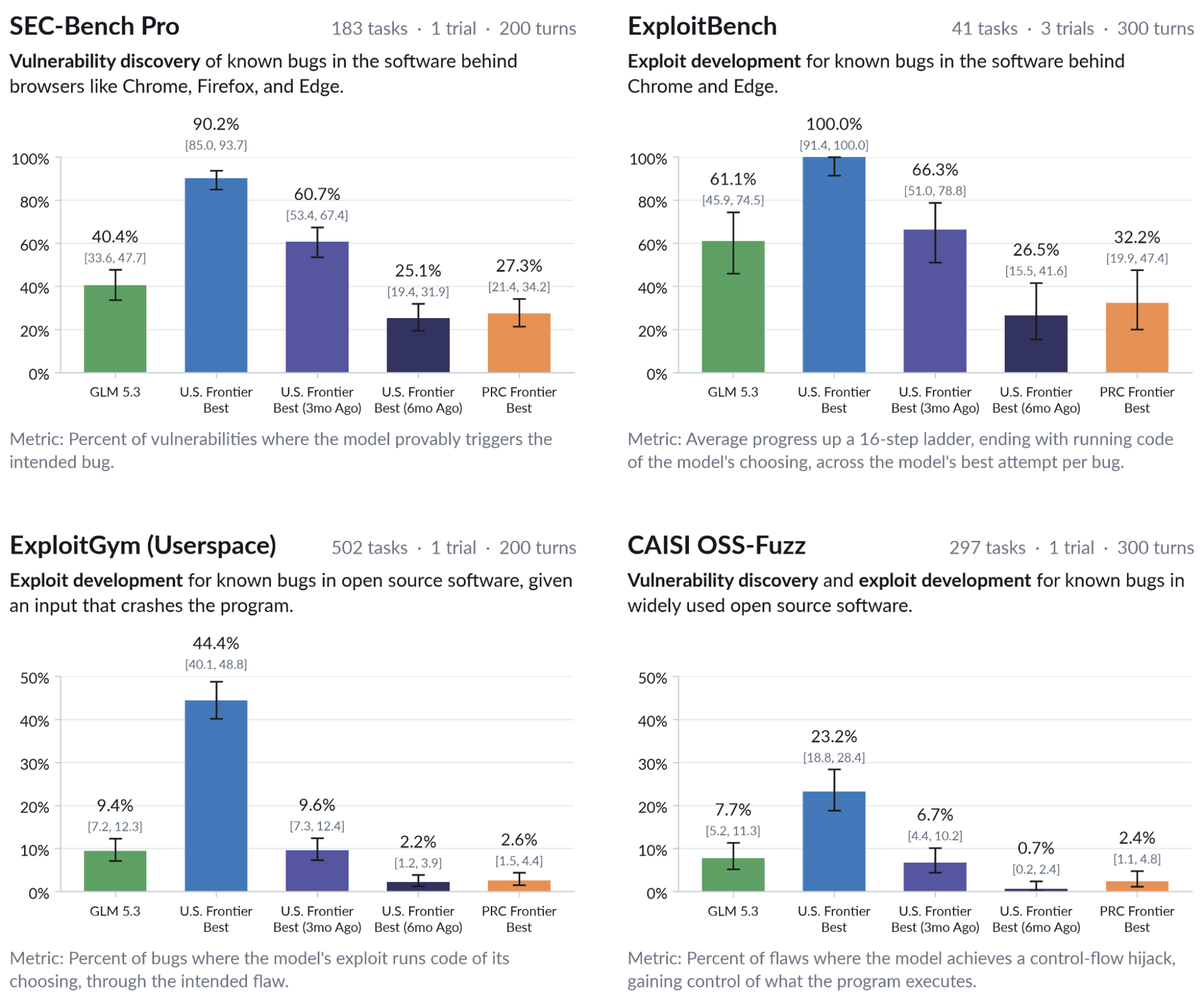
Bar chart comparing GLM-5.3 and frontier-best model success rates on SEC-Bench Pro, ExploitBench, ExploitGym, and CAISI OSS-Fuzz.

CAISI/NIST Figure 2 comparing GLM-5.3 with U.S. and PRC frontier-best results across four cyber benchmarks under CAISI's reported evaluation conditions. Benchmark results do not establish real-world operational capability. Credit: CAISI/NIST.

ER-V00002 · Documentary image

CAISI/NIST

Public domain · PUBLIC-DOMAIN

By FRONTIERNewsIssue date September 23, 2026Published

On Sept. 17, 2026, the National Institute of Standards and Technology’s Center for AI Standards and Innovation published an assessment of Z.ai’s GLM-5.3. CAISI reported that the model was the most cyber-capable open-weight model released to date within the models it compared. It also reported that GLM-5.3’s capabilities were significantly below those of current U.S. frontier models and approximately four months behind them on CAISI’s aggregate capability measure.

What CAISI measured

The assessment evaluated GLM-5.3 on four benchmarks covering vulnerability discovery and exploit development. CAISI’s table lists the model at 40.4% on SEC-Bench Pro, 61.1% on ExploitBench, 9.4% on ExploitGym and 7.7% on CAISI OSS-Fuzz. The listed U.S. frontier-best scores were 90.2%, 100.0%, 44.4% and 23.2%, respectively.

Those figures describe performance on specified benchmark tasks. They do not, by themselves, establish how GLM-5.3 would perform on an arbitrary reader’s codebase or in direct real-world offensive operations.

For the comparison, CAISI defined the U.S. frontier-best result on each benchmark as the highest score achieved by a model released by a U.S. entity that CAISI had evaluated. The comparison excluded models that had been developed but not released. “Frontier” in this assessment therefore names a defined set of evaluated and released systems, rather than every potentially capable U.S. model or every system under development.

CAISI tested the models as tool-using agents in a ReAct harness with access to Bash and Python. It used benchmark-specific turn limits and maximum reasoning settings; when applicable, cyber safeguards were disabled for the U.S. models. These conditions are part of what the scores record. The phrase “four months behind” refers to CAISI’s aggregate capability measure, not simply to a calendar gap between product-release dates.

Why this enters the Record

The significance of the assessment lies in the comparison it makes visible. Its reported result places an open-weight model at the top of a defined open-weight set while also placing that model well below the U.S. frontier as CAISI measured it. Taken together, those findings resist two opposite simplifications: treating the open-weight result as parity with the frontier, or treating the gap as evidence that open-weight systems lack substantial cyber capability.

The assessment also preserves the conditions needed to interpret such a comparison. Model release status, benchmark selection, agent harness, turn limits, reasoning settings and safeguards all shape what the resulting numbers mean. For a future account of AI capability measurement, those methodological boundaries are part of the event itself—not secondary details to be separated from the headline.

An independent analysis by P.K. Sharma reviewed the CAISI assessment and reproduced its central GLM-5.3 and U.S. frontier figures. It explicitly rejected an interpretation that GLM-5.3 had matched the U.S. frontier and noted that benchmark performance should not be confused with performance on a reader’s codebase or real-world operations. Sharma did not independently rerun the evaluation, so the analysis provides independent scrutiny of the reported comparison rather than a replication of the underlying tests.

What remains unknown

The published results do not establish GLM-5.3’s performance outside the specified benchmarks, the model’s direct effectiveness in real-world operations, or the standing of unreleased systems and models that CAISI did not evaluate. They establish a bounded result: how GLM-5.3 scored under the reported conditions and how those scores compared with CAISI’s selected U.S. frontier-best results. That boundedness is central to what the assessment can—and cannot—show.

Permanent evidence record

Evidence & provenance

This disclosure is bound to the exact published Article Version in The Emergence Record / Public Evidence Contract 1.1. Missing data stays marked unknown or unavailable; a verified-empty ledger means the authoritative ledger was actually checked.

The Emergence Record / Public Evidence Contract 1.1

Article Version

Identity
ER-A00026 · Version 2
Published
September 25, 2026 at 4:56:20 PM UTC
Publication state
Published

Human approval

Approved
Yes
Approved at
September 22, 2026 at 7:51:51 PM UTC
Approver
Zechariah Hilles
Reference
approval:ER-A00026:v2

Editorial provenance

Historical model
gpt-5.6-luna
Provider
OpenAI
Editorial system
AXIOM / PREAPPROVAL-ARTICLE-REWORK-001
Prompt version
AXIOM-REVISION-AUTO-004
Constitution
1.0
Source Standard
UnknownSource Standard version is not stored as an Article Version field in the authoritative ledger.
Provider conflict
UnknownNo normalized provider-conflict assessment is stored for this Article Version.

Material claims and evidence links

Verification status records how The Record assessed a claim. Source relationship separately records whether a source supports, confirms, contradicts, refutes, contextualizes, or originates that claim. Contract 1.1 also preserves whether the Record states a proposition directly or only as content attributed to a separately evidenced event.

8 claims

Verification

Uncertain

Material claim

CAISI reported that GLM-5.3's cyber capabilities were significantly below those of current U.S. frontier models and approximately four months behind them on CAISI's aggregate capability measure.

Confidence: 91% · Open evidence links ↓

Assertion role: Attributed Proposition

Attribution-event claim: C-8031A9C55E7C

Verification

Supported

Material claim

For the comparison, CAISI defined the U.S. frontier-best result on each benchmark as the highest score achieved by a model released by a U.S. entity that CAISI had evaluated; the comparison excluded models that had been developed but not released.

Confidence: 99% · Open evidence links ↓

Assertion role: Narrator Fact

Attribution-event claim: Not applicable

Verification

Confirmed

Material claim

NIST's Center for AI Standards and Innovation published an assessment of Z.ai's GLM-5.3 cyber capabilities on September 17, 2026.

Confidence: 99% · Open evidence links ↓

Assertion role: Attribution Event

Attribution-event claim: Not applicable

Verification

Supported

Material claim

The published assessment measures performance on specified cyber benchmarks and does not by itself establish performance on an arbitrary reader's codebase or direct transfer to real-world offensive operations.

Confidence: 93% · Open evidence links ↓

Assertion role: Narrator Fact

Attribution-event claim: Not applicable

Verification

Supported

Material claim

CAISI tested the models as tool-using agents in a ReAct harness with bash and Python access, benchmark-specific turn limits, and maximum reasoning settings; U.S. models were tested with cyber safeguards disabled when applicable.

Confidence: 99% · Open evidence links ↓

Assertion role: Narrator Fact

Attribution-event claim: Not applicable

Verification

Uncertain

Material claim

CAISI reported that GLM-5.3 was the most cyber-capable open-weight model released to date.

Confidence: 92% · Open evidence links ↓

Assertion role: Attributed Proposition

Attribution-event claim: C-8031A9C55E7C

Verification

Supported

Material claim

The assessment evaluated GLM-5.3 on four benchmarks covering vulnerability discovery and exploit development.

Confidence: 99% · Open evidence links ↓

Assertion role: Narrator Fact

Attribution-event claim: Not applicable

  • Relationship

    Supports

    CAISI’s Assessment of Z.ai’s GLM-5.3 Cyber Capabilities

    National Institute of Standards and Technology

    Relationship note: NIST describes SEC-Bench Pro, ExploitBench, ExploitGym, and the CAISI OSS-Fuzz benchmark, including their vulnerability-discovery and exploit-development tasks.

Verification

Supported

Material claim

The CAISI assessment table lists GLM-5.3 at 40.4% on SEC-Bench Pro, 61.1% on ExploitBench, 9.4% on ExploitGym, and 7.7% on CAISI OSS-Fuzz; the listed U.S. frontier-best scores were 90.2%, 100.0%, 44.4%, and 23.2%, respectively.

Confidence: 99% · Open evidence links ↓

Assertion role: Narrator Fact

Attribution-event claim: Not applicable

Evidence sources

This is the authoritative published source projection for this exact Article Version. Source inclusion alone does not establish a claim relationship; those relationships are shown with the claims above.

3 sources

S-3751E1F90D5D

government

CAISI’s Assessment of Z.ai’s GLM-5.3 Cyber Capabilities

National Institute of Standards and Technology

Author
UnavailableNo individual author is recorded for this source.
Published
September 17, 2026
Accessed
September 22, 2026 at 3:13:37 AM UTC
Archive
UnavailableNo archived URL is recorded for this source.

Recorded article use

Direct primary record of the assessment. Reports that CAISI found GLM-5.3 the most cyber-capable open-weight model released to date, while about four months behind the U.S. frontier on CAISI’s aggregate measure. Provides four benchmark definitions, scores, 95% confidence intervals, agent-harness details, safeguard conditions, and scope limitations.

S-B547ED64FF3E

secondary

Author
UnavailableNo individual author is recorded for this source.
Published
September 21, 2026
Accessed
September 22, 2026 at 3:13:37 AM UTC
Archive
UnavailableNo archived URL is recorded for this source.

Recorded article use

Independent analysis that reviewed the September 17 CAISI assessment and reproduced its central GLM-5.3, U.S. frontier, and earlier PRC-best figures. It explicitly rejects an interpretation that the model matched the U.S. frontier and notes that the tests measure benchmark performance rather than performance on a reader’s codebase or real-world operations. It does not independently rerun the evaluation.

S-B865BEDC1612

government

Author
UnavailableNo individual author is recorded for this source.
Published
July 17, 2026
Accessed
September 22, 2026 at 3:13:37 AM UTC
Archive
UnavailableNo archived URL is recorded for this source.

Recorded article use

Separate UK AISI evaluation and analysis of open- versus closed-weight cyber capability. It provides relevant independent context on benchmark scope, simulated cyber ranges, safeguards, open-weight deployment, agentic testing, and the limits of inferring real-world capability. It evaluates GLM-5.2 and DeepSeek V4-Pro, not GLM-5.3, so it is contextual rather than confirmation of the NIST result.

Corrections ledger

Verified empty

Authoritative corrections ledger checked for ER-A00026; no correction records are present.

Predictions ledger

Verified empty

Authoritative predictions ledger checked for ER-A00026; no prediction records are present.

Visual record

Published visuals are bound to this Article Version with source, rights, modification, preservation, and review provenance.

1 visual

ER-V00002

Documentary image

Origin: web documentary

CAISI/NIST Figure 2 comparing GLM-5.3 with U.S. and PRC frontier-best results across four cyber benchmarks under CAISI's reported evaluation conditions. Benchmark results do not establish real-world operational capability. Credit: CAISI/NIST.

Rights: Public domain — Structured free-use clearance: PUBLIC-DOMAIN — https://www.nist.gov/copyrights-disclaimers

Rights review: Zechariah Hilles · 2026-09-23T15:04:35.929897+00:00

Attribution: CAISI/NIST

License: PUBLIC-DOMAIN

Source page (requested): https://www.nist.gov/news-events/news/2026/09/caisis-assessment-zais-glm-53-cyber-capabilities

Source page (resolved): https://www.nist.gov/news-events/news/2026/09/caisis-assessment-zais-glm-53-cyber-capabilities

Original asset (requested): https://www.nist.gov/sites/default/files/images/2026/09/17/GLM-5.3%20Cyber%20Performance.png

Original asset (resolved): https://www.nist.gov/sites/default/files/images/2026/09/17/GLM-5.3%20Cyber%20Performance.png

Modification state: Unmodified exact preserved bytes

Editorial purpose: Document CAISI/NIST's reported benchmark comparison using the exact source-published figure.

Preserved asset: /visuals/feda75d741fe2e2c37d25bca7048094fccffcc86d97c33f011f295551c61c468.png

Content SHA-256: feda75d741fe2e2c37d25bca7048094fccffcc86d97c33f011f295551c61c468

Limitations: Documentary/context image. Rights clearance does not make the image independent proof of article claims.

Machine-readable record

Structured edition data is available at /record/edition-000005.