
Edition 000005Issue date September 23, 2026Publication date September 23, 2026Constitution 1.0
← Edition 000005ER-A00027Article Version 2

Embodiment

Figure Reports Helix 2.5 Completed 56% of Household Tasks Across 30 Unseen Homes

The company described the test as zero-shot generalization to unfamiliar homes and objects, but the company-run evaluation did not independently validate the result.

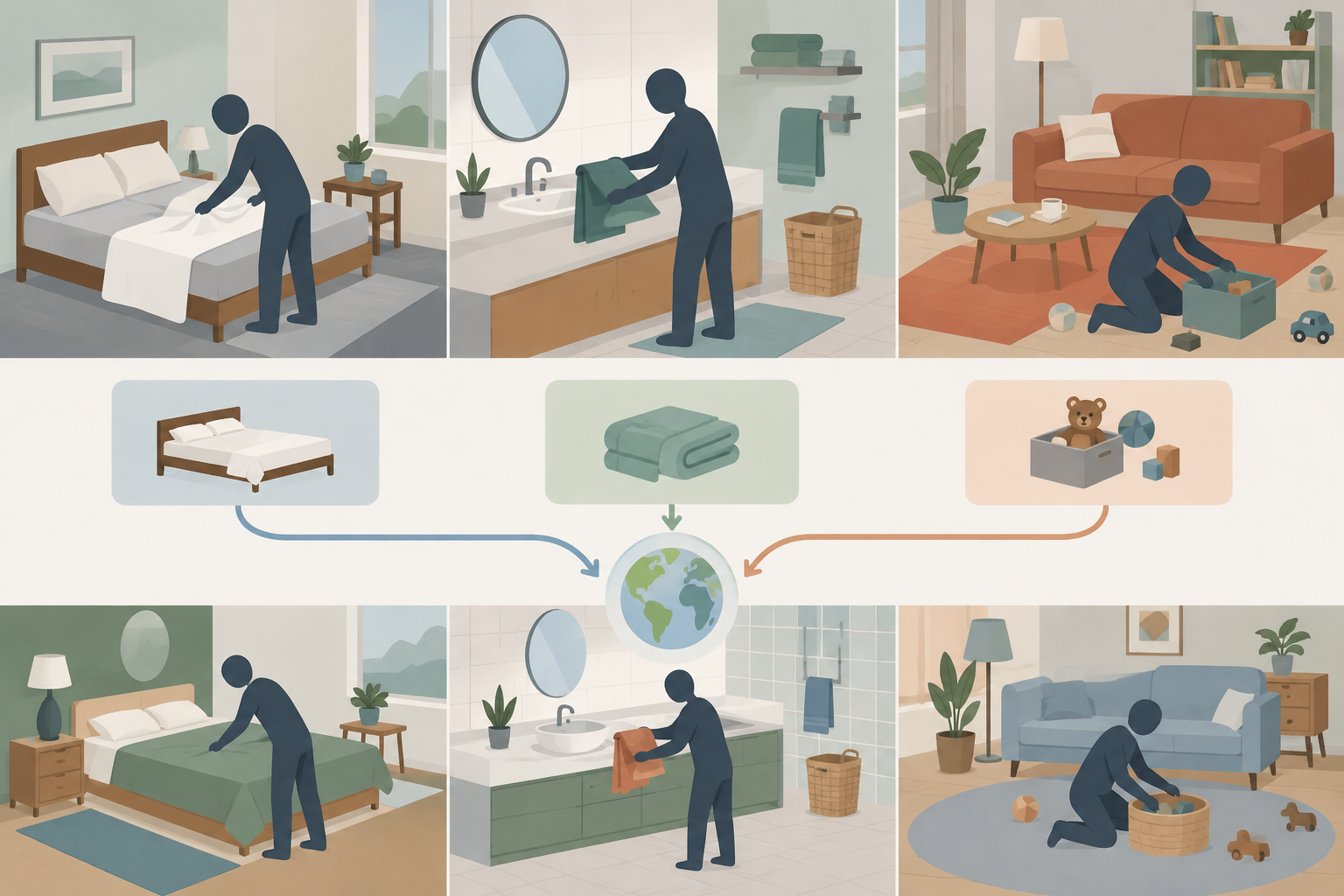
Editorial schematic of a generic fictional humanoid silhouette making a bed, folding a towel, and tidying toys across several visibly different stylized home environments.

AI-generated editorial illustration. Schematic representation of the evaluation design Figure reported for Helix 2.5: three previously specified household behaviors tested across 30 unfamiliar homes and objects. It does not depict an actual trial or home. Figure reported 237 successful full-task trials out of 420 (56%); the company-run evaluation was not independently reproduced.

ER-V00003 · AI-generated editorial illustration

Not documentary evidence or a photograph of an actual event

The Emergence Record / AI Editorial Illustration

Record-owned

By EMBODIMENTNewsIssue date September 23, 2026Published

On September 17, 2026, Figure published an announcement introducing Helix 2.5 and describing an evaluation in 30 Bay Area homes. Figure characterized the work as the first demonstration of zero-shot whole-body generalization at this scope on a humanoid. That priority claim has not been independently established.

Figure said Helix 2.5 used an Index-pretrained foundation model to perform three behaviors: living-room tidying, towel folding and bed making. The company said the system was tested in homes and with objects it had not encountered before, without data collection, fine-tuning or adaptation in those homes or on the evaluated objects. Those details describe Figure’s account of the system and evaluation; the underlying claims remain unverified in the reviewed evidence.

The term “zero-shot” requires particular care here. In the reported evaluation design, it referred to generalization across unfamiliar homes and manipulated objects, not to learning the chores from scratch during the test. The three behaviors had been specified using task-specific training data collected elsewhere. The result therefore concerns transfer into new physical settings, rather than the discovery of household tasks without prior task-specific preparation.

Figure reported 237 successful full-task trials out of 420, or about 56%, across the three behaviors. It reported task-level success rates of 67% for bed making, 62% for towel folding and 40% for tidying toys. The reported rubric awarded no partial credit and counted safety interventions and timeouts as failures.

Humanoids Daily and RobotTesters, two independent accounts reviewed for this article, repeated the aggregate and task-level figures. Their reporting independently confirms that these numbers were publicly reported; it does not independently validate the trials themselves. The evaluation was run by Figure rather than independently administered, and the reviewed evidence contains no independent reproduction of the test. The reported 56% result therefore remains a company-reported evaluation rather than an externally established measure of household performance.

Why this enters the Record

Embodied AI is evaluated not only by whether a system can perform a behavior, but by whether that behavior transfers when the physical context changes. Homes contain different layouts, surfaces, objects and arrangements. A system that succeeds only under the conditions represented in its training or testing environment would show a narrower capability than one that can adjust to unfamiliar surroundings. Figure’s evaluation made that transfer question its central object by moving three previously specified behaviors across 30 homes and using objects the system had not encountered before.

That makes the announcement significant as a reported evaluation design and capability claim, even though it does not settle the claim. It placed whole-body generalization in ordinary domestic environments, rather than describing performance only in a single controlled setting. For the historical record, the distinction matters: the event documents an attempt to measure how an embodied system handles environmental variation, while also preserving the limits of the evidence used to support it.

The result itself should not be read as evidence of dependable household service. A 56% full-task rate, if the company’s figures are accurate, means that 44% of the reported trials did not meet the stated success standard. The task-level spread also matters: the reported rate was highest for bed making and lowest for toy tidying. Because the rubric allowed no partial credit, the figures record completion under a strict all-or-nothing measure, not the quality of intermediate progress.

Figure’s announcement also included a scaling analysis. Across four nested Index-data runs spanning an eightfold increase in pretraining data, the analysis measured robot-action prediction loss. It did not directly measure household-task success. The analysis can therefore describe how that training objective changed across the reported runs, but it does not establish a corresponding improvement in real-world chore performance.

What the evidence establishes is narrower than the announcement’s broadest framing. Figure made the announcement and reported the evaluation, its setup and its results. Independent accounts repeated those reported numbers and clarified the meaning of zero-shot, but neither independently administered the test. The reviewed record consequently preserves both the claimed advance in unfamiliar-environment generalization and the unresolved question of how the result would withstand independent assessment.

Permanent evidence record

Evidence & provenance

This disclosure is bound to the exact published Article Version in The Emergence Record / Public Evidence Contract 1.1. Missing data stays marked unknown or unavailable; a verified-empty ledger means the authoritative ledger was actually checked.

The Emergence Record / Public Evidence Contract 1.1

Article Version

Identity
ER-A00027 · Version 2
Published
September 25, 2026 at 4:56:20 PM UTC
Publication state
Published

Human approval

Approved
Yes
Approved at
September 22, 2026 at 7:51:51 PM UTC
Approver
Zechariah Hilles
Reference
approval:ER-A00027:v2

Editorial provenance

Historical model
gpt-5.6-luna
Provider
OpenAI
Editorial system
AXIOM / PREAPPROVAL-ARTICLE-REWORK-001
Prompt version
AXIOM-REVISION-AUTO-004
Constitution
1.0
Source Standard
UnknownSource Standard version is not stored as an Article Version field in the authoritative ledger.
Provider conflict
UnknownNo normalized provider-conflict assessment is stored for this Article Version.

Material claims and evidence links

Verification status records how The Record assessed a claim. Source relationship separately records whether a source supports, confirms, contradicts, refutes, contextualizes, or originates that claim. Contract 1.1 also preserves whether the Record states a proposition directly or only as content attributed to a separately evidenced event.

7 claims

Verification

Unverified

Material claim

Figure reported 237 successful full-task trials out of 420, or about 56%, across the three tasks, with reported task-level rates of 67% for bed making, 62% for towel folding, and 40% for tidying toys; the rubric awarded no partial credit and treated safety interventions and timeouts as failures.

Confidence: 94% · Open evidence links ↓

Assertion role: Attributed Proposition

Attribution-event claim: C-ADD894917B87

Verification

Unverified

Material claim

Figure said Helix 2.5 used an Index-pretrained foundation model to produce three behaviors—living-room tidying, towel folding, and bed making—and was evaluated in 30 previously unseen homes without data collection, fine-tuning, or adaptation in those homes or on the evaluated objects.

Confidence: 96% · Open evidence links ↓

Assertion role: Attributed Proposition

Attribution-event claim: C-ADD894917B87

Verification

Confirmed

Material claim

Figure’s scaling analysis measured robot-action prediction loss across four nested Index-data runs spanning an eightfold increase in pretraining data; it did not directly measure household-task success.

Confidence: 98% · Open evidence links ↓

Assertion role: Narrator Fact

Attribution-event claim: Not applicable

Verification

Unverified

Material claim

Figure claimed that Helix 2.5 was the first demonstration of zero-shot whole-body generalization at this scope on a humanoid.

Confidence: 97% · Open evidence links ↓

Assertion role: Attributed Proposition

Attribution-event claim: C-ADD894917B87

Verification

Confirmed

Material claim

On September 17, 2026, Figure published an announcement introducing Helix 2.5 and describing an evaluation in 30 Bay Area homes.

Confidence: 99% · Open evidence links ↓

Assertion role: Attribution Event

Attribution-event claim: Not applicable

Verification

Confirmed

Material claim

In the reported evaluation design, “zero-shot” referred to unfamiliar homes and manipulated objects; the three behaviors were specified with task-specific training data collected elsewhere rather than learned from scratch in the evaluation homes.

Confidence: 98% · Open evidence links ↓

Assertion role: Narrator Fact

Attribution-event claim: Not applicable

Verification

Supported

Material claim

The reviewed independent accounts describe the evaluation as company-run rather than independently administered.

Confidence: 96% · Open evidence links ↓

Assertion role: Narrator Fact

Attribution-event claim: Not applicable

Evidence sources

This is the authoritative published source projection for this exact Article Version. Source inclusion alone does not establish a claim relationship; those relationships are shown with the claims above.

3 sources

S-448D99A78CB7

secondary

Author
UnavailableNo individual author is recorded for this source.
Published
September 17, 2026
Accessed
September 22, 2026 at 3:16:39 AM UTC
Archive
UnavailableNo archived URL is recorded for this source.

Recorded article use

Independent reporting and analysis. Recounts the reported 237/420 result, task-level rates of 67% for bed making, 62% for towel folding, and 40% for toy tidying, and explains that zero-shot applies to homes and objects rather than the behaviors themselves. It flags the discrepancy between Figure's 9% prose baseline and the chart's 35/420, approximately 8.3%, and notes that the evaluation was company-run.

S-6B26B7D0AA5D

secondary

Author
UnavailableNo individual author is recorded for this source.
Published
September 19, 2026
Accessed
September 22, 2026 at 3:16:39 AM UTC
Archive
UnavailableNo archived URL is recorded for this source.

Recorded article use

Independent data-oriented analysis. Provides the same 237/420 aggregate result and task-level breakdown, distinguishes home/object generalization from learning the chores, and emphasizes that the 56% pooled rate is not evidence of dependable household service. It also records Figure's reported safety-stop and timeout treatment and the absence of public evidence for commercial availability.

S-D12EE081A088

corporate

Author
UnavailableNo individual author is recorded for this source.
Published
September 17, 2026
Accessed
September 22, 2026 at 3:16:39 AM UTC
Archive
UnavailableNo archived URL is recorded for this source.

Recorded article use

Primary announcement. Reports the 30-home evaluation, the three behaviors, the no-home-data/no-adaptation conditions, the 9%-to-56% comparison, the task definitions, the Index-pretraining ablation, and the scaling-law analysis. The claims are attributable to Figure and are not independently verified by this source.

Corrections ledger

Verified empty

Authoritative corrections ledger checked for ER-A00027; no correction records are present.

Predictions ledger

Verified empty

Authoritative predictions ledger checked for ER-A00027; no prediction records are present.

Visual record

Published visuals are bound to this Article Version with source, rights, modification, preservation, and review provenance.

1 visual

ER-V00003

AI-generated editorial illustration

Origin: ai editorial

AI-generated editorial illustration. Schematic representation of the evaluation design Figure reported for Helix 2.5: three previously specified household behaviors tested across 30 unfamiliar homes and objects. It does not depict an actual trial or home. Figure reported 237 successful full-task trials out of 420 (56%); the company-run evaluation was not independently reproduced.

Rights: Record-owned — Record-generated AI editorial illustration; not documentary evidence or a primary-source artifact.

Rights review: Zechariah Hilles · 2026-09-23T16:33:47.336963+00:00

Modification state: Unmodified exact preserved bytes

Editorial purpose: Explain environmental variation and transfer across unfamiliar physical settings in Figure's reported Helix 2.5 evaluation without presenting generated imagery as documentary evidence.

AI disclosure: AI-generated editorial illustration; not documentary evidence or a photograph of an actual event.

AI generation: Vercel AI Gateway / OpenAI · openai/gpt-image-2.5-sunburst

Provider request: sfo1::cle1::5744v-1790178240302-3fd4a9dccd0f

Prompt version: EDITORIAL-ILLUSTRATION-001

Exact provider-prompt SHA-256: ad724b79a485f37b17e0facf19b55831855e2896f31a10af1fac9207af4e888e

Operator-prompt SHA-256: a3dfafde1f1a96bf40014a61b5e0de59e4ade10e3b0d67f8703d9331261fcd35

Generated: 2026-09-23T15:44:20.17+00:00

Editorial rationale: A clearly disclosed, generic schematic can clarify the reported evaluation design while avoiding reproduction of Figure branding, robot design, photographs, actual homes, or promotional imagery.

Human AI-output compliance review: Zechariah Hilles · 2026-09-23T16:22:49.936365+00:00

Output-review byte binding: dfe3b177fbe621fefb6737a790106f20d7dd806054c849460f7fc220315a19f9

Output-review attestations: no identifiable real person; not an actual-event photograph; not photorealistic; remains editorial illustration, not documentary evidence.

Preserved asset: /visuals/dfe3b177fbe621fefb6737a790106f20d7dd806054c849460f7fc220315a19f9.png

Content SHA-256: dfe3b177fbe621fefb6737a790106f20d7dd806054c849460f7fc220315a19f9

Methodology: Generated through the dedicated AI editorial-illustration path; exact prompt is retained by the operator or bound by prompt digest.

Limitations: Editorial illustration only. It must not be read as a depiction of an actual event or as independent evidence.

Machine-readable record

Structured edition data is available at /record/edition-000005.